
Thomas Doty – Storyteller
|
|
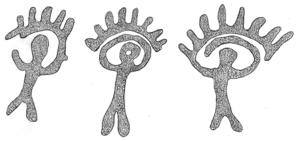
At Their Best, Stories Heal
The stories we tell each other entertain us on those long winter nights. But they do more than that. They teach us many things about our culture ... our history, our folklore, our beliefs.... Even practical things like how to build a house or where to find huckleberries in the mountains, or the best fishing places along the river. But stories do even more. When they are doing their best work, stories heal. A skilled storyteller can make us feel better about things we might not be feeling too good about. Stories touch us deeply where we feel our emotions, and they stay with us for a long time. Doctors know this. So do therapists, ministers, teachers. And so do storytellers.
The best way to understand the healing power of storytelling is to tell you a story about a student who found her story....
A number of years ago I was Storyteller in Residence at a school on the Oregon coast. My first day was also a 4th-grade girl's first day. She had moved from eastern Oregon -- a huge change of environment from the desert to the coast -- and not only was she going through the usual new-kid-in-school traumas, she had it doubly hard. The girl had long skinny legs, and from her first day, the students teased her. These were the same children she had hoped to make friends with. This made her sad.
While in one of my workshops she composed a story she asked to perform for the entire class. This was not a requirement for the workshop. We were working in small groups. Each storyteller's first performance would be for a small audience of friends. But the girl insisted. This took courage. She mustered up her nerve, and the story had an amazing impact on her classmates.
Her story was about Crane, a large bird with skinny legs, and how the other animals teased her. "This isn't right," thought Crane. "I shouldn't be judged by how I look." Crane decided to show the other animals that there was more to her than skinny legs.
In her story was a river and the animals wanted to see what was on the other side. But the river was too deep to wade, too swift to swim, and this was before boats and bridges, even before birds had wings.
One day, Crane stretched one of her skinny legs across the river. She made the first bridge and the animals walked across. But no animals teased Crane. They knew she might start shaking her leg when they were halfway across at the deepest and swiftest part of the river, dump them in, and that would be their end!
As the girl told her story, the class was dead quiet. The truth of the story, the moral, the theme, the meaning, the power, the wisdom, the teaching -- don't judge people! -- came across loud and clear. Then the bell rang. Her classmates went to recess.
Out on the playground, an amazing thing happened. Oral tradition happened. The students who had heard the story told it to those who hadn't, and just like stories have been spreading around for thousands of years, that story spread all through the school. By the end of the day, nearly all of the students had quit teasing her. Within a week, she had some good friends.
That's what I call a healing story ... a little something to make the world a better place.
Photo Credits | Privacy | Donate
Website © 1997-
by Thomas Doty.